The ICAR Atlas and Claw Disease Codes. A Guide to Designations in Trimming Reports

Effective herd health management requires precision. To ensure hoof trimming reports are readable and allow for data analysis, standardized codes based on the international ICAR standard are used. Here is a complete guide to the disease designations you will find in professional trimming applications, such as Cownt.
Why do we use ICAR abbreviations? The International Committee for Animal Recording (ICAR) has developed an atlas that serves as a “common language” for trimmers worldwide. By using codes (e.g., DD, SU, WLA), we avoid misunderstandings. A “red leg” might mean something different to one trimmer than to another, but the code DD is always unambiguous.
Below you will find a list of disease codes divided into categories, along with their descriptions.
1. Infectious Skin Diseases
These conditions are caused by bacteria and depend mainly on hygiene in the barn.
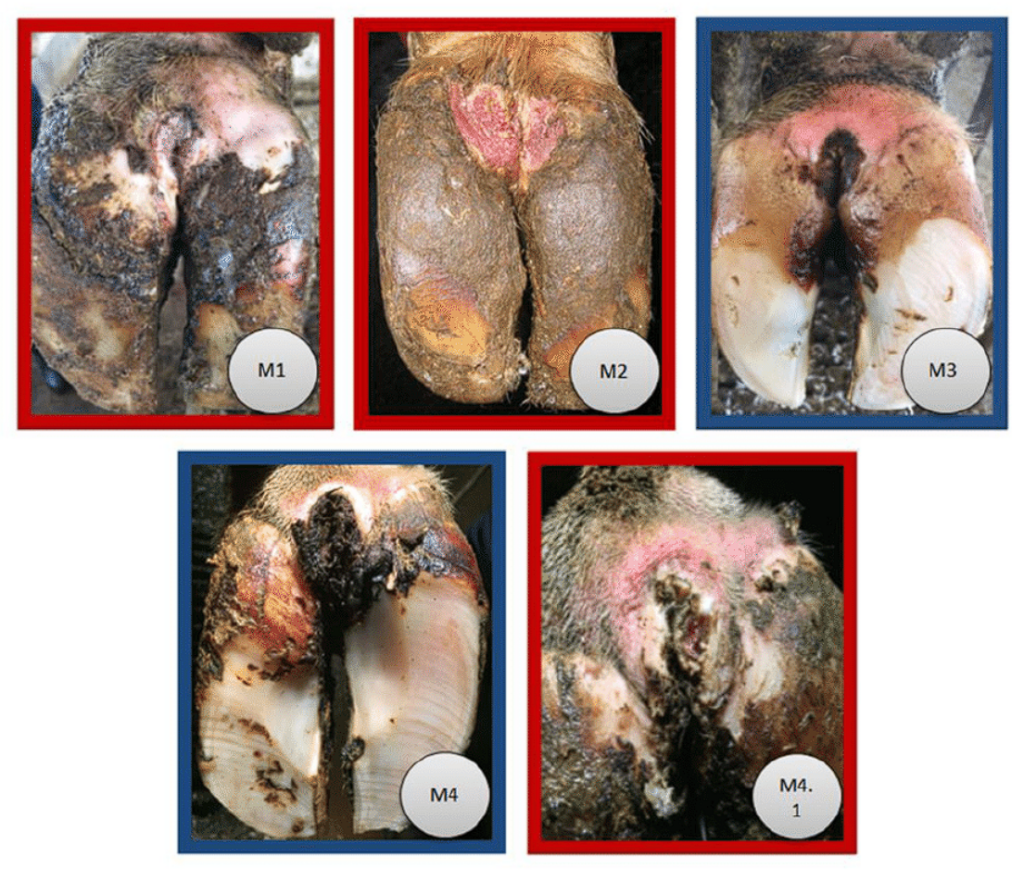
M1: Early stage ulcerative lesion (0–2 cm in diameter).
M2: Painful ulcerative lesion >2 cm in diameter.
M3: Healing stage where the lesion is covered by a scab.
M4: Chronic stage characterized by dyskeratosis (abnormal keratinization) or surface proliferation.
M4.1: Chronic lesion with a small area of ulceration.
The border colors visible in each photo classify digital dermatitis lesions into two types: active (red border) and inactive (blue border). Photos courtesy of Prof. Fabio Lima, from the scientific article “Altered Microbiomes in Bovine Digital Dermatitis Lesions, and the Gut as a Pathogen Reservoir” published in PLOS One.
- DD (Dermatitis Digitalis) – Digital Dermatitis (Mortellaro disease) The most common infectious disease. It manifests as a painful, red lesion (often granular, resembling a strawberry), usually in the heel area. It causes severe lameness.
- ID (Dermatitis Interdigitalis) – Interdigital Dermatitis Infection of the skin between the toes (digits). The skin is moist, red, and may emit an unpleasant odor. It is often a precursor to more serious problems, such as heel horn erosion or granulomas.
- IP (Phlegmona Interdigitalis) – Interdigital Phlegmon (Foot Rot) Acute bacterial inflammation of the subcutaneous tissue. Characterized by sudden swelling of the entire pastern (“thick leg”), symmetrical spreading of the toes, fever, and severe pain. Requires immediate antibiotic treatment.
2. Horn and Sole Diseases
Conditions often resulting from nutritional errors (acidosis), mechanical overload (concrete), or negligence in trimming.
- WLA (White Line Abscess) An advanced form of white line disease. Separation occurs between the wall and the sole, where dirt and stones penetrate, creating an abscess. The pus often seeks an outlet upwards, erupting at the coronary band.
- SU (Sole Ulcer) A defect in the horn at a typical site (at the junction of the heel and sole), exposing the live corium. One of the main causes of non-infectious lameness. Often requires relieving the weight from the affected claw (applying a block).
- TS (Thin Sole) A condition where the horn layer of the sole is too thin (e.g., due to excessive wear on concrete or overly aggressive trimming). The sole yields under thumb pressure, causing pain to the animal when walking.
- TU (Toe Ulcer) A specific type of ulcer located at the toe of the claw. It is often a complication of shortening the claw too much (bleeding toe) or results from necrosis of the pedal bone.
- TN (Toe Necrosis) Deep infection involving soft tissues and bone within the toe area. This is a very serious condition, difficult to treat, and often leading to permanent damage to the claw.
3. Structural and Other Changes
Conformation defects and other pathological changes.
- IH (Interdigital Hyperplasia) – Corn/Tyloma Overgrowth of skin and subcutaneous tissue in the interdigital space. It forms a characteristic fold (“cauliflower”), which can be pinched by the toes and become infected (often co-occurs with ID).
- CC (Corkscrew Claw) A conformational defect where the claw wall curls under the sole. This causes unnatural weight bearing and promotes ulcer formation. It often has a genetic basis.
- HF (Horn/Heel Fissure) Cracks in the hoof capsule (horizontal or vertical) or deep fissures within the heel. They can be the result of trauma, past febrile diseases, or drying out of the horn.
Special Events in the App
The registration system also allows for recording events that go beyond standard disease classification but are crucial for herd management.
- MI – Mechanical Injury Not every lameness results from disease. The MI code is used in cases of sudden mechanical damage that is not the result of a disease process. Examples: penetration by a foreign body (nail, sharp stone), collision with fencing elements, avulsion of the hoof capsule.
Control Statuses: VET and CTR
The application allows not only for diagnosis but also for planning further actions. Marking a cow with the appropriate status is a signal for the farmer:
- VET (Vet): The claw requires veterinary intervention (e.g., administration of systemic antibiotics for foot rot, anesthesia for amputation, or advanced surgery).
- CTR (Check/Control): The cow requires re-examination by the trimmer within a specific time (e.g., block removal, assessment of ulcer healing).
Understanding these codes is the key to cooperation between the farmer and the trimmer. Thanks to precise records in the Cownt system, instead of a generic “cow is lame,” you receive specific knowledge that allows for effective treatment and prevention of problems in the future.